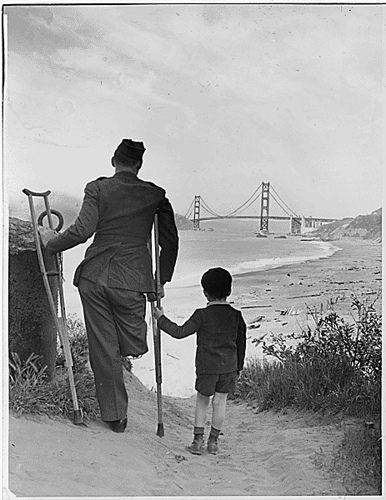
The 5 stages of a stand-up guy’s life: Invisible, expendable, untouchable, forgettable, disposable.

Like a fish needs a bicycle? Think again.Photo by: The U.S. National Archives

It’s Veterans Day as I write this, a holiday so important to the Ruling Class that they didn’t turn it into a three-day weekend. Fear you nothing, though: This will not prevent the federal government and the banks (but I repeat myself) from taking the day off anyway.

It’s vitally important to celebrate the sacrifices of the brave men who served our country, which celebration will entail having nothing to do with any of them. It’s vitally important to have a cargo-cult holiday once a month or so, and those nettlesome vets ought to be glad they haven’t been entirely eclipsed by Thanksgiving.

And thank goodness Columbus Day is there to soak up all the excess autumnal outrage, or else someone might notice that military veterans – especially the ones who died in battle – are overwhelmingly male. We can celebrate the upside of war – begrudgingly, with department store sales and family get-togethers – but we cannot openly rejoice in the fruits of masculine virtue.

That would be just, of course, but justice toward men is… Old-fashioned? Uncultured? How about sinful…?

For it is a sin in our culture to notice and praise the virtues of ordinary men. We have plenty of attention for the extreme outliers, for the best and the worst at everything. But for the just-plain-regular stand-up guy who gets up every day and goes off to do a shitty job for minor ducats, often risking life and limb in the process, we can’t even spare a yawn.

And yet that man is the backbone of Western Civilization, the get-it-done guy who actually gets things done. He produces five-times his own living costs in income, passing all of that along to his wife and kids and grandkids – assuming he is not robbed of his family. He takes all of the risks imposed upon us by perilous reality, incurring all of the resultant injuries. He defends us in wartime, and for this he is scorned and neglected in peacetime. And unless he is lucky enough to (more…)

Posted in Splendor! | 2 Comments

Why are middle-aged white guys killing themselves in record numbers? What do they have to live for?

Civilization is fathered into existence. If you want to destroy The West, destroy fatherhood. The rest will take care of itself – and the fathers will take care of themselves in due course, too.Photo by: Ann Wuyts

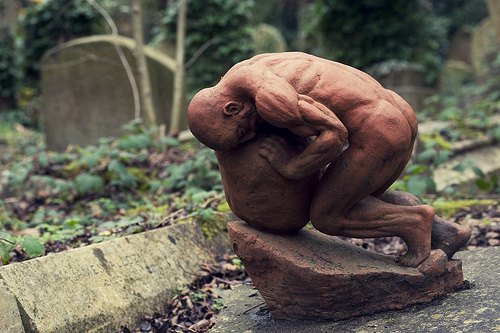
Why does Sisyphus keep pushing that rock up the hill? Because he’s doomed – or he believes he is – that’s why.

What happens when he realizes he can quit whenever he wants?

As it turns out, he eats a bullet.

This was big news last week, for about a minute-and-a-half, but in fact it is news to no one. If you haven’t noticed that you’re losing too many white middle-aged male friends and relatives to suicide, it could be you’re clueless enough to be an academic.

Consider this, from the linked article:

For Vancouver psychologist Dan Bilsker, what’s striking is how little we really understand about why the numbers peak when men are in their 50s. “It doesn’t fit previous models of things driving suicidal behaviour.”

In those models, by their 50s, men should “be feeling more in control of their lives, have worked out a lot of issues, be coping pretty well,” he says. After all, most of them are working, they’ve had jobs, relationships, children, life experiences. So the high suicide rate “raises a more disturbing model.”

Say what?!

Do you want to hear something interesting about poor dead Sisyphus, lying there in a puddle of his own brains? He left us because, from his point of view, he had nothing left to live for. Pretending that he was the dad in Father Knows Best in order to pretend not to understand his despair is simply to visit still further cruelties on the dead.

Why would Sisyphus quit, once he realizes he can? Duh…

Work hard, settle down, get married, build a home and a family – then have it all ripped away, all at once, with everything you’ve worked for destroyed and with what should have been lifelong storgic relationships torn asunder, never to be fully repaired.

Trade that treasured home for a cramped rental as you try to get by on what’s left of your income, after (more…)

Posted in Splendor! | 5 Comments

The plot to the story that will change everything forever for everyone? Hard work pays off.

You don’t have to be Rocky to know what drove him.Photo by: Dr. Abdullah Naser

Just when you think things around here can’t get any more exciting, we pivot without warning from narrative art to raw naked grammar. And not just any grammar: Latin grammar.

I posted a story this morning built around a very Romanly admonition: Si laboraveris, vinces. (If you work, you will win.) That expression, the story and yesterday’s Church of Splendor homily all turn on the subjunctive condition named ‘the future more vivid.’

Now, that’s plenty of fun just by itself, but stop to consider this: The best possible English translation of that phrase – “hard work pays off” – is also the four-word plot summary of every true benedy.

I reject the terms comedy and tragedy because it is much too easy to laugh at maledy. And I want more than a seemingly-happy ending from a story for it to be deemed a benedy. The stories I consider benedies are about learning and mastering new ideas. They’re about how hard work pays off.

And that’s why they are so effective at helping people change their lives: They are about real-life values and virtues that people can deploy to change their lives.

As a manifestation of the integrity of everything, those four words – “hard work pays off” – also illuminate the structure of benedic stories: For the hard work to pay off for both the characters and the audience, the transition must seem to be authentic, palpable and arduous over time. That’s why the movie Rocky resonates with so many people, not because they want to box but because they can relate, analogically, to battling daily adversities in the on-going quest for excellence.

How do you write a story like that? It’s easy. Pick a worthy goal and then show people you love pursuing it. The goal can be romance or career or family, and the details can be whatever you want the world to see in greater detail. But if your story is a benedy, I already know the plot: Hard work pays off – my favorite.

And so (more…)

Posted in #MyKindOfBenedy, Poetry and fiction | 2 Comments

A future more vivid.

“Learning is about mastery; we go down that street all the time. And learning is about competence, being able to get the job done. And learning is about success, which in the instant matter means having the means to buy expensive new toys. Learning is about confidence, standing tall in your mind. And learning is about every virtue I could ever think to name. But there is a point at which learning is just about learning. You soak up knowledge when and where you can, and if you happen to find a use for it later, so much the better.”Photo by: Kuba Bożanowski

A Ramblin’ Gamblin’ Willie Christmas story

December 15, 1999

“Salve, caudex,” the big little boy said to his father.

“Salve, caudex,” the father replied.

The boy turned to me, a stranger, and said, “Salve, caudex.” I smiled at him and he confided, “That means, ‘Hello, blockhead.’”

We were sharing a bench at the mall, as one must at Christmas. When I had sat down it was just the father and me at opposite ends of the bench. But then the big little boy – too young to be big, too tall to be little – had come bounding out of the toy store across the way.

He was his father in miniature, seven or eight years old but very tall, very lean. His hair was brown and a little shaggy and his eyes were gray and very bright. He had his father’s large hands and long fingers, and it won’t be long before he has his father’s prominent proboscis. He walked fast and talked fast and he moved his body with a blinding abruptness.

“You like it, don’t you?” his father asked.

“Boy, do I! I think that’s the best video game system ever! That’s what I want for Christmas!”

“How interesting.”

The boy spun to me and said, “That means, ‘I don’t care.’”

I said: “I’m sorry?”

“When he says ‘how interesting,’ it means he doesn’t care.”

“What it means,” said the father, including me, I think, because he felt he had to, “is that you have said nothing to motivate me to act. You haven’t asked for (more…)

Posted in Christmas brutality, Poetry and fiction, Willie stories | 2 Comments

Famous In Vegas Only: A peek inside the head of a Headliner.

Libertarian art is the three-act comedy.

Extracted from the Ramblin’ Gamblin’ Willie book Losing Slowly, available at Amazon.com. I have great ideas. You have money. We should trade.

A Ramblin’ Gamblin’ Willie story

Las Vegas, July 23, 2013

Who expects to see a Headliner at McDonald’s? Nobody, right? That’s why it’s the perfect disguise.

My world and the world of Las Vegas overlap at about five in the morning, when I’m getting up and Sin City is stumbling off to a half-passed-out slumber – that thick, deep sleep that leaves you wondering, when you awake, why your pillowcase smells faintly of vomit. The town’s official motto is ‘What happens here stays here,’ but the second-choice slogan was more accurate, I think: ‘If you didn’t puke your guts out, it wasn’t Vegas.’

But The Headliner is at war with all of that, I think, despite his job. He’s a jogger, for goodness’ sake. He was wearing gym shorts and an old tee shirt and running shoes that surely cost more than my whole wardrobe. Even so, he looks just like the picture of him you see on The Strip. If the other bleary-eyed breakfast-eaters didn’t recognize him, it could be because, in real life, his head is not sixty feet tall.

Or it could just be because people can’t imagine that normal folks and so-called ‘celebrities’ can occupy the same spaces: If I can see you and talk to you just like a regular guy, you can’t be famous. I’m just the opposite: I can imagine anything. In consequence, I am delighted to take in whatever the world throws at me.

We were sitting at the opposite corners of our booths, across the little walkway from each other. Intimate enough to make eye-contact, distant enough to maintain distance: The Willie Dance is a delicate thing.

I said, “You rocked on Leno the other night.”

He smiled, and it was a Headliner’s smile, a thousand dollars a tooth would be my guess. “I get one dark day a week. It took three months to schedule three minutes.” He laughed and I laughed even though it was kind of a weak-tea joke. A comedian says (more…)

Posted in Poetry and fiction, This is Vegas, Willie stories | 4 Comments

#MyKindOfBenedy: How can something as silly as a movie make your life ever-better over time?

I am replacing the terms tragedy and comedy – with words that mean something.Photo by: Tim Green

Jan Schlösser, bless his bits, asks this about last week’s video:

Greg, would you mind giving some examples of narrative art that you would consider prime examples of benedy (apart from your own works)?

Glad to. Truly delighted. Let’s take up cinema, since it’s more likely to be universally-accessible.

What we’re talking about is benedy, which is a word I made up to distinguish types of stories. In a benedy, the story arc will move from worse to better: The main character(s) and the overall situation will be better at the end.

This is contrasted with maledy, also a word I made up, in which the action moves from better to worse.

I make this distinction because the word comedy gets conflated with both farce (which is often maledy) and satire (which is always maledy), while tragedy is equated with the generic word drama – which will very often have a benedic story arc.

The terms benedy and maledy are simply ways of understanding the arc of a story. The motivation in a benedy is always the protagonist’s free will, where in a maledy the driving force is typically anything other than that free will. In a benedy, the protagonist wins. In a maledy, he loses. In a benedy, the protagonist triumphs by deploying his mind against malign fates. In a maledy, malign fates overwhelm the protagonist. In a benedy, the hero eats the bear. In a maledy, the bear eats the hero.

As further disambiguation, digest this updated chart:

Benedy Maledy
Action moves from worse to better better to worse
Action is driven by protagonist other forces
Action is caused by protagonist’s choices villain/chance/fates/gods
Outcome is determined by protagonist’s actions other forces
Philosophical message is libertarian, individualist, egoistic authoritarian, collectivist, anegoistic
Ending is happy sad
Audience leaves feeling inspired, uplifted depresssed, down-trodden

Note that a story is not a benedy simply because you have someone to root for. War movies are maledies, overall, as are super-hero movies. In crime and action dramas, the antagonistic forces, whatever they are, are generally well-treated and the classical liberal institutions conservatives and libertarians typically support are often bested by vengeance and retribution, which those classical (more…)

Posted in #MyKindOfBenedy, Poetry and fiction | 5 Comments

Wish you could watch or read my kind of benedy? At least you can follow #MyKindOfBenedy on Twitter.

There are good stories down that way.

Photo by: Duncan Hull

My kind of Twitter #hashtag: #MyKindOfBenedy.

I want to talk about the kinds of stories that will do the job I want done – the job you should want done – so I’ll summarize plot ideas as I think of them, linking back to something that makes my point.

We put up with dour, despairing, slave-making art for no good reason. We can do much better. I’m happy to show how.

Posted in #MyKindOfBenedy, Poetry and fiction | 1 Comment

Anastasia in the light and shadow

A Ramblin’ Gamblin’ Willie story

The very first thing she said to me was, “I’m Anastasia.”

She had pronounced the name ‘Anna-stay-juh’ but I took care to be more formal. I nodded gravely and said, “‘Ah-nah-STAH-ziuh’. I’m honored.”

She giggled delightedly. “Why’d you say it that way?”

“To lilt, to laugh, to dance, to dream. To fly, to sigh, to sing, to speak. To embroider the air, to perfect it with the perfect sound: ‘Ah-nah-STAH-ziuh’.”

She giggled again and that was answer enough.

She was four-and-a-half on the day we met. Not awfully, terribly short, but at no risk of scraping her head on anything. She had a round little face that had borrowed too much mischief to be cherubic but was angelic nevertheless. Her hair was brown and it was almost always almost everywhere; it was obviously brushed and tied and obviously instantly disarrayed by her mischievous wanderings. She was a beautiful child, beautiful inside and out, but her eyes were the crowning glory of her nobility. They were bluer than blue, deep and dark and purple, as purple as the crest of a dynasty. They were clearer than any gemstone, and they seemed not to reap the light but to sow it. For all the days I knew her, I could never see enough of those purple gemstone eyes.

“What’re you doing there?” she asked. I was sitting in the shade of a little olive grove reading a book. She was standing on something behind the block wall of the property next door, just her head and shoulders above the wall.

“House-sitting. You know what that means?” She shook her head and her hair flew into a more advanced state of disarray. “It’s like baby-sitting only easier.”

“Why’re you doing it?”

I shrugged. “The official answer is, I’m helping out a friend. The unofficial answer is, TV, refrigerator, hot and cold running everything. Does that make any sense to you?”

It might have or it might not, but we’ll never know, because she changed the subject. “I have a kitten. His name is ’Sputin.”

I said, “Rasputin. Somebody likes Russian names. Say it: ‘Ra-spyoo-tin’.”

“Why?”

“Just say it. ‘Ra-spyoo-tin’.”

She said, “‘Ra-spyoo-tin’.” Her voice (more…)

Posted in Poetry and fiction, Willie stories | 12 Comments

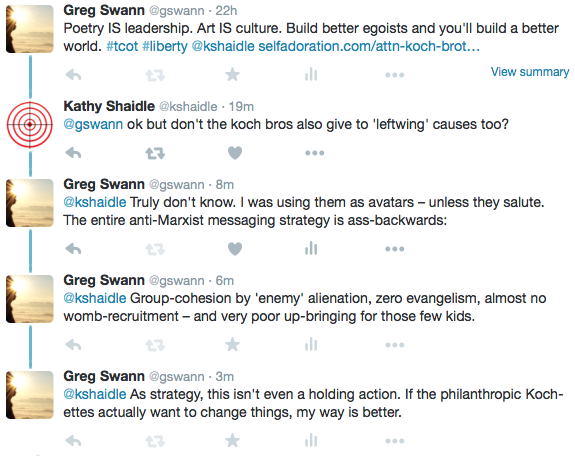
How would I program my three-hour prime-time TV Koch-block? Family style.

Politics is downstream from culture. How do you fix the culture? Stop telling people that they’re wrong and start showing them how to be right instead.

Politics is downstream from culture, sure. But how do you fix the culture? Stop telling people that they’re wrong and start showing them how to be right instead.

What if the Koch Brothers (or some other rich benefactor) were to take my advice on art?

What if they recognized that the current libertarian/conservative messaging strategy is badly flawed, serving mainly to stir up bad feelings among perpetually-warring factions – while recruiting virtually no new adherents?

What if they took account that while John Wayne, John Galt and John McClane do a bang-up job of preaching to the choir, they turn out to be worse than useless at bringing in the sheaves?

What if philanthropists and ideologues in quest of a better America woke up to the notion that a better America requires better Americans – and that better Americans cannot be cultivated by coercion, verbal abuse or ridicule but only by, you know, cultivation?

What if they shared in my epiphany that the message that will recruit new members – and retain and sustain the current crowd – is poetry, not polemics? Art, not argument – and an art aimed at enlarging the middle class by celebrating everyday middle class virtues: Self-reliance, committed monogamy, a devoted family life – and well-defended physical, mental and moral values.

What if they decided to try things my way?

My advice to the Koch Brothers was to buy a three-hour block of prime-time television. I have all kinds of other ideas about how things might be done, but Wednesday night – often the divorced dad’s night with his kids – is a good place to start.

So what if they let me program that block of time? What would I do with it?

The big-picture answer should be easy to suss out: Family programming. There is no need to lecture anyone – and no benefit to be realized from it. Artistry is show-don’t-tell, but even then it’s not necessary to set up High Noon over and over again. Instead, the art that will effect the changes libertarians and conservatives want will simply show everyday families working through everyday real-life dilemmas (more…)

Posted in #MyKindOfBenedy, Poetry and fiction | 3 Comments

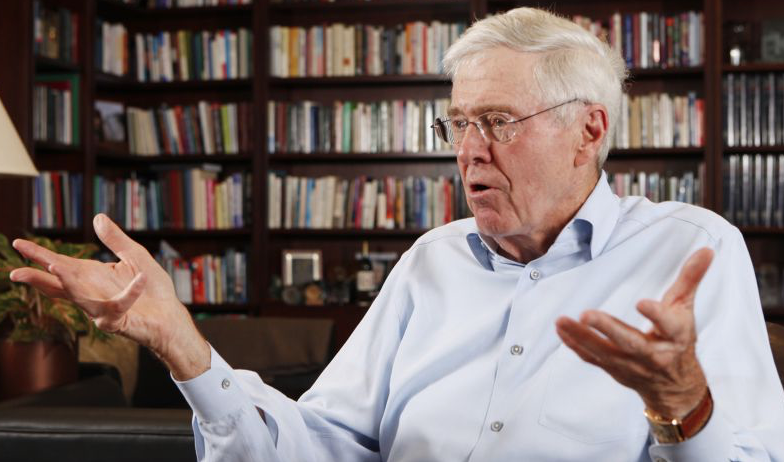
Attn: Koch Brothers: “Cultivate humans, and they’ll cultivate everything else you’re looking for.”

We find the world we’re looking for. Here’s what I see: Look at all them books...

We find the world we’re looking for. Here’s what I see: Look at all them books…

I know precisely two things about the Koch Brothers:

1. They spend a lot of money trying to sway voters toward human liberty.

2. Marxists hate them for doing it.

The second observation would seem to argue for the efficacy of the first – except for, you know, the part about the ever-diminishing human liberty. No, Marxists revile all opposition, particularly well-funded opposition, even if it’s ineffective.

And the money spent by the Koch Brothers and other political patrons is largely wasted.

Why?

Adults are rarely swayed by rhetoric, for one thing, and the Koch strategy is all but entirely focused on evangelizing adults. Still worse, the Koch arguments sound suicidal to the folks they’re aimed at. Despite all the crap we love to tell ourselves about emancipation, comfortable slaves do not campaign for manumission. Too much the contrary.

I’m not picking on the Kochs. The entire anti-Marxist messaging apparatus is ass-backwards: The wrong arguments made the wrong way to the wrong audience.

No one was ever scorned or scolded into better behavior, which is why “Chortle, chortle, chortle, you’re wrong, wrong, wrong!” is such a spectacularly useless claim – even though the entire conservative publishing apparatus is convinced it will finally work this time.

Moreover, people change their views for their reasons, not yours. Even when the rhetoric comes across as more than hectoring, it still seems self-serving to the listener. Should he ask, “What’s in it for me?” the response is going to sound to him like more pie in the sky – to be paid for, he surmises, by the food out of his own mouth.

Why the heck doesn’t that work?

Here are three things the Koch Brothers and other anti-Marxist philanthropists can do to get more bang for the messaging buck:

1. Focus on children as well as adults. It’s next-to-impossible to fix a broken adult, but children can bet set on a better lifelong course while they are still unbent.

2. Sell the benefits, not the features. Better-for-everyone sounds great, but better-for-me is what gets me out of bed (more…)

Posted in #MyKindOfBenedy, Poetry and fiction | 8 Comments

Go, go, Shylygirl! Understanding my #kidlit Indiegogo campaign as a marketing appeal.

“Leadership is more than just going first.” –Shyly D. Lightful, The scientific art of getting lost, for dogs

“Leadership is more than just going first.” –Shyly D. Lightful, The scientific art of getting lost, for dogs. http://igg.me/at/ShylyLost

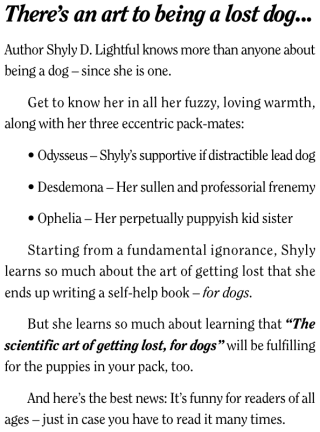
I have a brand new Indiegogo campaign as of this morning, a crowdfunding appeal for my forthcoming #kidlit bedtime story book, The scientific art of getting lost, for dogs.

I’ve been talking about it a lot lately – hard-headed philosophy served up as rollicking fun for kids of all ages – and later today at church I’ll be going into the over-arching aesthetics as meta-philosophy. There will be riots in the virtual pews, I’m sure. For now I want to talk about what I’m up to as a marketer.

First, art is a business, and I wish I had better evidence for that proposition. I am as appealing as glowing plutonium to the publishing biz – which is perfectly understandable. In the kingdom of the blind, the one-eyed man is dinner. I am happy enough to be ignored, if the alternative is to be imprisoned or exterminated.

But indie publishing promises to choke every choke-point standing between me and my vast audience of dozens. It has, too, to some degree. But the problem for indie books is buzz. Publishing-house books have it, either from the fame of the author or with paid-for publicity. Indie books have to make their own.

Enter Indiegogo. I see it as a marketing channel masquerading as a crowd-funding platform. Some campaigns are all or mostly fund-raising appeals, but many are some or mostly on-line shopping: Support the project by buying the product.

I like that part, because, considered as actual, tangible trade goods, books are a relatively-easy product to produce. It is the writing that’s hard – or so I’m told. In any case, it’s duck soup for me to knock out a book, taking care of every back-end job from soup to nuts. It’s the getting the books sold and read part that’s the problem for me.

So I’m wondering if Indiedgogo could prove to be an outstanding way for me to stand out from the crowd.

The site lives and dies by the long-copy advertising format, and the ideas (more…)

Posted in Poetry and fiction, Splendor! | 1 Comment

Making the art that will change the culture with a shaggy-dog self-help book – written by a shaggy dog.

“Why a self-help book for dogs? Because leadership is more than just going first.” –Shyly D. Lightful

“Why a self-help book for dogs? Because leadership is more than just going first.” –Shyly D. Lightful

I’m a happy man. Everything I’ve been grailing for in narrative art for the past two years is coming together for me now:

Launching Sunday: The scientific art of getting lost, for dogs, a benevolently funny shaggy-dog story – written by a shaggy dog – for four-year-olds.

The theme? The ontology and teleology of leadership, loyalty and storgic love within the family.

Oh, yes! The world is my oyster. I can take a gruesome homework assignment like that and make you and your kids laugh at it over and over again.

You wanted an art to change the culture. I can show you how to make it.

Like this:

And now you know what matters most to Big-O. He’s a giant of a dog, a full-blood Bloodhound, russet red with a tiny patch of white on his breast. I’m a mutt, so I’m the runt in our pack, barely 60 pounds. The two Coon Hounds come in at around 80. But Odysseus is big even for a male Blood. He’s easily 110 pounds – before dinnertime. He’s big and game and goofy and naturally dominant, the uncontested leader of our little family – when our people aren’t around.

He went through the long, slow process of getting to his feet, engaging each muscle and bone separately. Don’t kid yourself; he can be up in a shot when he needs to be – like when someone drops a slice of ham in the kitchen. But normally he likes to express his regal indomitability by taking his time when there is time to be taken. Rank has its privileges.

He sauntered over to us, the question of the hour still burning in his big, droopy brown eyes: “Dinnertime?”

You’d think he wouldn’t have to ask, but Desi always knows to the minute when it’s time for us to be fed. Don’t ask me how; the girl matches patterns incessantly. But you don’t have to know time to the minute to know that the sun was too high in the sky (more…)

Posted in Splendor! | 2 Comments

My delightful dog Shyly teaches me how to sell plush toys – from beyond the grave.

The real Shyly, virtually invisible, as always, with the real Odysseus.

The real Shyly, virtually invisible, as always, with the real Odysseus. That’s one of the real Ophelia’s toys on the floor behind them. And Desdemona? She fades…

My dog Shyly, writing in The scientific art of getting lost, for dogs:

I didn’t know what the boy was getting out of our discussion. His arms were wrapped around me by now, and he was absorbing my boundless warmth. I’m not bragging. Our people call me Shyly D. Lightful, and I’m sure that’s because I capture almost all the light that hits me, reflecting almost none of it back. That’s why I’m so hard to see in pictures – but it’s also why I’m so easy to hug in person.

I’m not actually trying to sell stuffed animals. That just came for free, as a way of understanding Shylygirl. Ophelia will make Sociable hearts melt…

Posted in Splendor! | 2 Comments

Beta testers needed for a comic #kidlit bedtime book – about a family of talking dogs.

“Leadership is more than just eating first?”

“Leadership is more than just eating first?”

I have a kid’s book coming – maybe a few kid’s books. The comic premise: Self-help by dogs for dogs. The book I’m working on now will be called “The scientific art of getting lost, for dogs,” and it features four of the dogs I’ve loved best in my life, including Odysseus, whose enormous snout you see here.

It’s written to be a bedtime book, a chapter book that parents read to older kids – say four years old and up. It will be a workable chapter book for ambitious independent readers, too, but there is a second track of jokes for adults readers – who, after all, could get stuck reading it thirty-eleven times.

I need beta testers, as it were, adults to read a chunk of the book to kids to see how it’s working. You’re welcome to just read it yourself, and I’m interested in hearing about that experience, too. But I’m trying to make a strong connection with kids, so I’m eager to hear if I’m getting the job done.

I would love to hear from an illustrator, too, and if anyone knows anybody at Pixar…

Sneak a peek and let me know what you think.

Posted in Splendor! | 3 Comments

Visibility, viability and the scientific art of getting lost, for dogs.

“Can you see the real me?”

“Can you see the real me?”

I’ve been playing visibility games for a solid year now. A visibility game, for me, is an intense empathy game where I probe you deeply enough to unearth the image of you that you wish you could see being reflected back to you by the people you meet. Then I go ahead and reflect that image back to you. This is often delightful to people, but it is always surprising to them. Loki smiles either way.

It’s a game in the Game Theory sense, not so much in the “Hey! That was fun! Let’s do that again!” sense. I don’t do it with bad people, and I focus only on virtue even in good people. After all, what it is it I’m trying to cultivate? But it is a brutal kind of intimacy, even so, not alone because it’s so rare – for each one of us – actually to be seen by other people.

Just that much is funny to me: Everyone wants to be seen, seen, seen, but no one even dares to take the briefest peek at anyone else. I’m the opposite, both ways: I don’t care who can or can’t see me, as long as I can. And I never tire of trying to figure out everything.

Want proof? I’ve been playing visibility games with four dogs we love. All four are dead, except in our memories, but soon they’ll live on in your memories, too. I’m taking the philosophy we talk about here and recasting it as a children’s bed-time story – ostensibly as a chronicle written by, about and for dogs. For now, at least, the book is called The scientific art of getting lost, for dogs, and the authoress is one Shyly D. Lightful, seen barely-visibly in the photo above.

Here’s an extract, the Act I curtain as it were:

Odysseus walks slowly – for him. That’s good, because I still have to hustle to keep up with him. “You’re the leader,” I agreed. “But to what?”

To this he answered nothing. He’s not rude, just distractible. I am, too, for (more…)

Posted in Splendor! | 1 Comment